Selecting a hand-painted Claude Monet oil painting reproduction requires looking past the famous composition to examine how light, paint thickness, and canvas weave interact on the physical wall. A great reproduction does not mimic a flat photograph. It captures the energetic brush marks, optical color mixing, and subtle reflections that define French Impressionism.
Short answer: an authentic hand-painted Monet reproduction must show physical impasto relief, layered color harmonies, and a balanced aspect ratio that honors the original canvas proportions. When evaluating a piece, inspect the visible brushwork along water surfaces, verify the paint body under side lighting, and confirm that the canvas dimensions suit your room scale before placing an order.
Language accuracy is equally important for collectors and decorators. A studio reproduction is an entirely new hand-painted work created after a historic masterwork. It is not the historical museum piece, nor should it be described as official, licensed, or museum-certified without specific institutional backing. By focusing on physical paint handling and canvas craftsmanship, buyers can select beautiful impressionist works with clarity and confidence.
For collectors seeking authentic French Impressionist wall art, explore our curated Claude Monet collection, browse the Claude Monet reproductions category, or submit custom size requests through our custom oil painting studio.

Understanding Impasto And Broken Color In Monet Reproductions
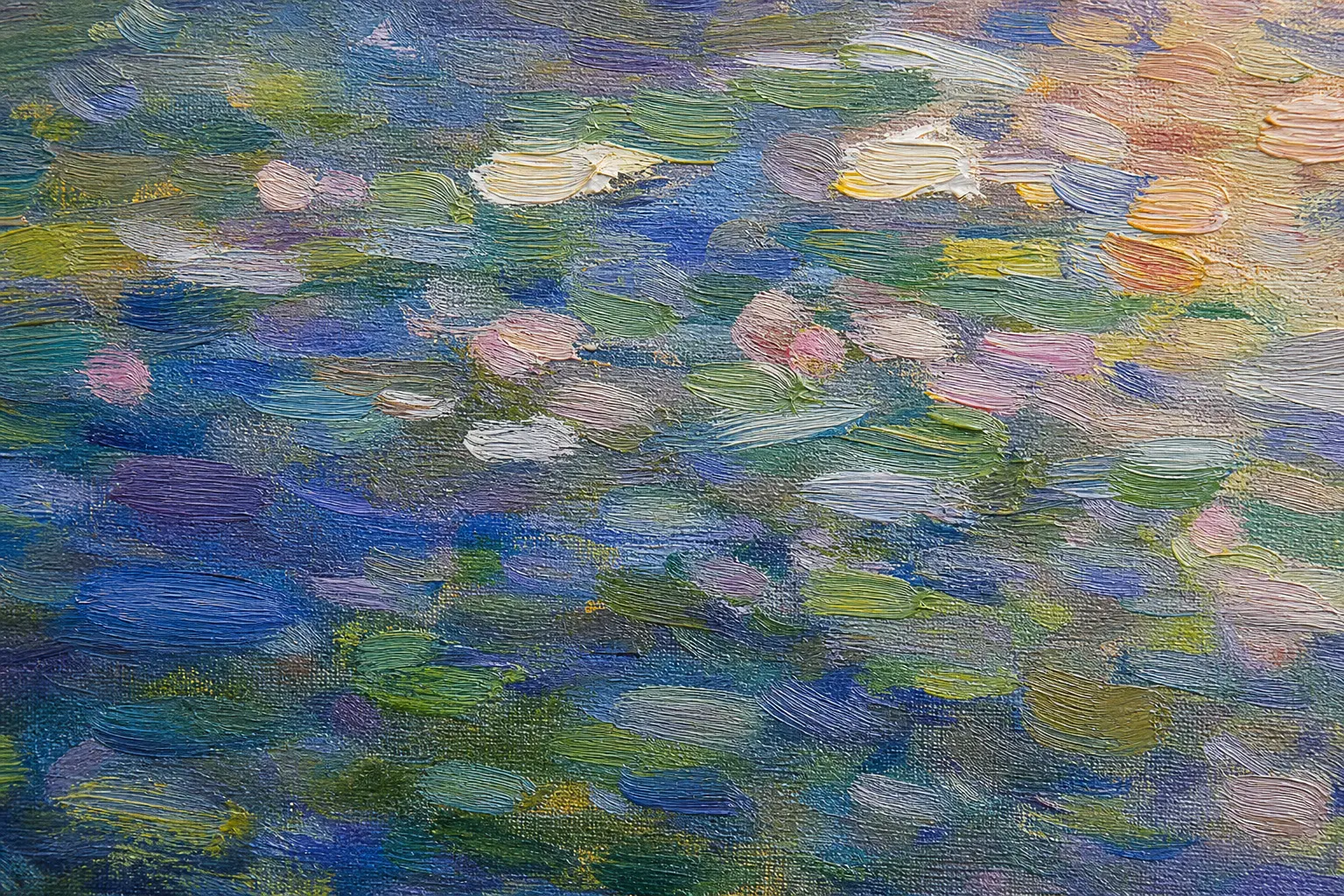
Claude Monet revolutionized 19th-century painting by abandoning flat academic glazes in favor of visible, textured brush marks known as impasto. Instead of smoothly blending pigments on the palette, Monet placed distinct strokes of unmixed paint side by side directly on the canvas. Up close, these strokes appear as vibrant dashes of pure color; step back several feet, and the viewer’s eye blends them into shimmering water, dappled sunlight, or shifting mist.
When shopping for a Monet reproduction, the primary indicator of authentic studio craftsmanship is the physical topography of the paint. A high-grade hand-painted oil replica features raised ridges along water lily petals, dense dabs across weeping willow branches, and tactile paint build on sunlit ripples. In contrast, flat digital canvas prints (giclées) or machine-embossed textured prints lack dimensional paint layers, resulting in a lifeless, uniform appearance under indoor illumination.
Evaluating The Impressionist Color Palette And Natural Light
Monet famously declared that black does not exist in nature, substituting deep violets, rich cobalt blues, and earthy burnt umbers to represent shadows. His garden landscapes at Giverny, seascapes along the Normandy coast, and atmospheric views of London and Venice depend on harmonious color temperatures rather than harsh graphic outlines.
In a quality oil painting reproduction, the color palette must reflect this sophisticated optical harmony. Notice how warm pinks, creamy whites, and golden yellows interlock with cool cerulean and viridian greens across pond reflections. Cheap copies often rely on synthetic, oversaturated pigments that look artificial under domestic lighting. Dedicated painters carefully layer artist-grade oil pigments to achieve soft transitions between highlights and ambient shadows.
Before selecting a specific subject, consider the natural lighting conditions of your display space. Rooms with cool northern exposure benefit from the warm, golden glows found in Monet’s sunrise and harvest scenes. Conversely, sun-drenched south-facing rooms provide an ideal setting for cool water lily compositions, oceanic cliffs, and snow landscapes.

| Monet Artwork Subject | Key Physical Characteristic | Optimal Room Placement | Viewing Distance |
|---|---|---|---|
| Water Lilies (Nymphéas) | Dense broken-color brushwork, floating horizontal lily pads, reflective ripples | Living rooms, bedrooms, master suites, tranquil reading lounges | 6 to 12 feet for optical blending |
| Argenteuil River & Regattas | Linear boat masts, directional water strokes, bright open sky highlights | Home offices, dining rooms, hallways, transitional foyers | 5 to 10 feet for balanced composition |
| Etretat Cliffs & Seascapes | Rough textured wave spray, sculptural chalk arches, dynamic cloud sweeps | Executive studies, coastal retreats, expansive feature walls | 7 to 14 feet for dramatic visual impact |
| Haystacks & Poplars | Thick circular impasto, heavy atmospheric haze, contrasting seasonal light | Dining rooms, libraries, traditional hearth walls | 6 to 10 feet for tonal depth |
The Seine near Argenteuil - Serene Waters - Textured Oil
Argenteuil river landscape reproduction (Master Studio)Est. Value Price range: $400.00 through $654.00
The Sea, Port in Amsterdam - Maritime Scene - Textured Canvas
claude monet (Master Studio)Est. Value Price range: $369.00 through $603.00
The Sea at Amsterdam - Nautical - Textured Oil
claude monet (Master Studio)Est. Value Price range: $362.00 through $695.00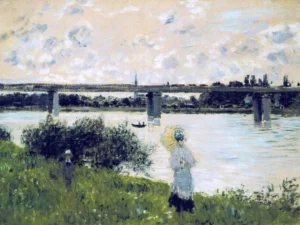
The Promenade near the Bridge of Argenteuil - Serene - Hand-Painted Oil
claude monet (Master Studio)Est. Value Price range: $369.00 through $1,500.00
Selecting The Correct Canvas Proportions And Room Scale
One common pitfall when purchasing impressionist reproductions is selecting arbitrary standard dimensions that force awkward cropping. Monet carefully calibrated the horizon line and edge tension of his compositions. For example, stretching a horizontal landscape into a square frame or forcing a panoramic water scene into a standard 24×36 inch canvas can ruin the delicate balance of sky and water.
When selecting a canvas size, prioritize the original aspect ratio of the artwork. If an original masterpiece was painted in a 3:4 or 2:3 ratio, maintaining those proportions preserves the spatial breathing room around key focal elements. Custom oil reproductions allow collectors to order scaled dimensions that preserve the composition while fitting the target wall width.
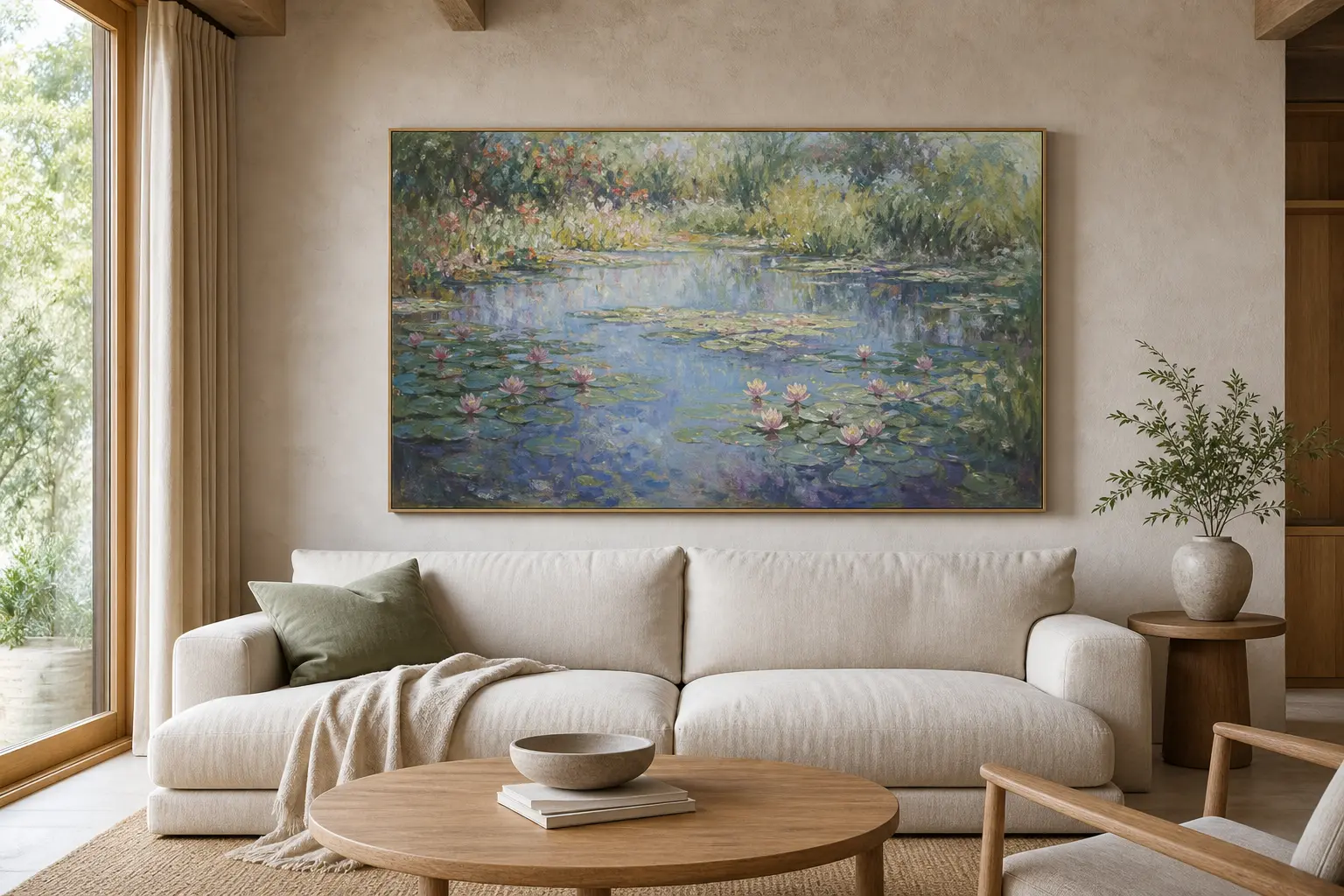
As a rule of thumb, artwork hanging above a living room sofa, console table, or fireplace mantel should span between 60% and 75% of the furniture’s total width. Because Monet paintings lack severe dark borders, they can comfortably occupy generous wall expanses without feeling visually oppressive or heavy.
Linen Canvas, Stretcher Bars, And Framing Choices
The longevity and structural integrity of an oil painting reproduction depend directly on the underlying materials. High-grade studios paint exclusively on heavyweight, primed Belgian or French linen canvas rather than cheap synthetic cotton blends. Linen possesses tight, uneven fibers that provide excellent tensile strength and a natural weave texture that complements impressionist paint strokes.
Proper framing elevates an impressionist painting without overwhelming its delicate color scheme. Traditional French ornate gilt frames with aged gold leaf provide authentic historical warmth, especially in formal dining rooms and classic sitting areas. For transitional or contemporary interiors, a slim floater frame in natural oak, antique bronze, or brushed gold provides crisp architectural edges while allowing the textured canvas perimeter to breathe.
When framing unstretched canvases, ensure that solid kiln-dried wood stretcher bars are used to prevent warping over seasonal humidity shifts. Gallery-wrapped canvases with painted edges offer an attractive unframed alternative for minimalist and modern decor schemes.
Verifying Studio Quality Before Shipment
Reputable oil painting reproduction studios maintain a structured photographic review process before shipping any completed canvas. Because oil paint takes several weeks to cure through natural oxidation, inspecting high-resolution photographic proofs ensures that color balance, detail fidelity, and texture meet buyer expectations prior to international transport.
During the review stage, request high-resolution close-up photographs taken at acute angles to verify physical brushstroke relief. Check that lily pads, tree branches, and architectural elements feel spontaneous and lively rather than stiffly outlined. Reliable studios also provide detailed guidance on stretch bar assembly and secure worldwide tube or crate shipping.
To learn more about verifying hand-crafted authenticity, review our hand-painted oil painting verification guide or compare physical standards in our museum quality reproduction standards guide. For overall spatial layout tips, consult our living room oil painting scale guide or explore our broader Master Artists collection.
Custom Sizing And Tailored Monet Compositions
While standard catalog sizes suit many residential spaces, unique architectural settings often demand tailored solutions. Whether framing an expansive double-height foyer, fitting a narrow hallway alcove, or selecting a focal centerpiece for a corporate boardroom, custom oil painting services bridge the gap between historic art and contemporary interior architecture.
When requesting a custom Monet reproduction, supply clear wall measurements, ambient lighting notes, and your preferred framing style. Experienced master artists can adapt the scale of the composition, fine-tune background color saturation to complement existing upholstery, or compose multi-panel triptychs based on Monet’s panoramic water lily installations.
Collaborating directly with specialized painters in Dafen Oil Painting Village provides direct access to time-honored oil painting traditions, rigorous quality control, and custom sizing flexibility without middleman retail markups.
Claude Monet reproduction FAQ.
Direct answers for collectors evaluating paint texture, color fidelity, custom sizes, and canvas framing before ordering.
A genuine hand-painted oil reproduction displays physical impasto with variable paint thickness, raised brush ridges, and natural stroke irregularity under side lighting. Canvas prints, even those coated with clear texture gels, remain flat and mechanically uniform across the entire surface.
Yes. Custom dimensions are achievable through hand painting, provided the artwork aspect ratio is respected. Professional painters adjust canvas proportions to fit specific wall spaces while ensuring that critical compositional elements and natural perspective are preserved.
Classical French carved gilt wood frames with antique gold patina suit traditional spaces, while slim floating frames in light oak, walnut, or muted champagne metallic suit modern interiors by providing clean borders without enclosing the painted edges.
No. They are newly painted studio interpretations crafted by professional artists inspired by historic public domain masterworks. They are not the historical museum originals and do not carry museum authorization or institutional certification.
Display the painting away from direct, harsh sunlight and moisture sources. Dust the textured impasto surface gently using a soft, dry natural bristle brush or clean microfiber cloth. Never use water, chemical detergents, or aerosol glass cleaners directly on an oil painted canvas.