Vincent van Gogh was a Dutch painter associated with the Post-Impressionist movement who became one of the most famous artists in history – if not the most – creating over two thousand artworks during about a decade of production. A deeply passionate soul, his biography remains the most emblematic example of the "visionary artist" who redefined the limits of color and emotion.
To understand his work is to recognize that he did not paint what he saw, but what he felt. His journey was one of radical honesty, where every brushstroke served as a heartbeat, and every color was a psychological state. At DafenArts, we approach his legacy as a living curriculum, translating his 19th-century energy into hand-painted masterpieces for the modern collector.
“I am seeking, I am striving, I am in it with all my heart.” — Vincent van Gogh
Vincent van Gogh: The Visionary Behind the Canvas
Vincent Willem van Gogh (1853–1890) was no accidental genius. His decade-long career was a relentless, almost feverish pursuit of a new visual language that broke the chains of 19th-century academicism. Between 1880 and 1890, he produced an astounding 2,100 artworks, including 860 oil paintings—a pace of production that remains staggering to this day. While his life ended in obscurity, his posthumous influence became the cornerstone of Modern Expressionism, influencing everything from the Fauvism of Matisse to the structural experiments of Paul Cézanne.
He rejected the rigid, photographic perfection of the Parisian salons, opting instead for a raw, visceral application of paint that prioritized internal emotional truth over external reality. This shift was revolutionary; it transformed the canvas from a window into a mirror of the human psyche. By liberating color from its descriptive function—painting a sky not because it was blue, but because he felt blue—Vincent allowed the spectrum to express joy, sorrow, and spiritual longing, forever changing how humanity perceives the world. This emotional gravity is what makes a Van Gogh reproduction the perfect "Statement Piece" for high-end residential and commercial interiors.
Early Life, Devotion, and the Theo Correspondence
Born in the Netherlands in 1853, Van Gogh’s early life was a series of restless transitions and a desperate search for purpose. He served as an art dealer in London and Paris, a teacher in England, and a lay preacher in the impoverished Belgian coal mines of the Borinage. These perceived failures were essential to his development; they forged his deep empathy for the human condition and the dignity of the marginalized, which became the emotional substrate of his art.
In 1880, at age 27, Vincent finally surrendered to his true calling. This journey was sustained by the unwavering financial and emotional support of his brother, Theo van Gogh. Their lifelong correspondence—a collection of over 600 documents—provides a psychological map of an artist’s mind unparalleled in history, documenting the struggle between creative ecstasy and profound despair. This level of emotional honesty is what we strive to capture in every Vincent van Gogh reproduction, ensuring the "soul" of the artist is present in every stroke, reflecting a psychological depth similar to the late works of Rembrandt.
The Earthy Honesty of the North: From Nuenen to The Potato Eaters
Before the vibrant, sun-drenched yellows of his later years, there was the somber, grit-filled reality of the Netherlands. During his time in Nuenen (1883–1885), Vincent focused on the rugged lives of weavers and farmers. His 1885 masterpiece, The Potato Eaters, captured the essence of this period. Using a palette of raw umbers, sienna, and dark greens, he sought to paint people who had "dug the earth with those very hands they put in the dish."
This period established his commitment to painting the "truth," however unpolished or "dirty" it might appear to the elite. At DafenArts, we recognize that these early works require a different type of mastery—a focus on dramatic shadows and Chiaroscuro. We use earthy, heavy-bodied pigments to recreate the tactile honesty of these northern scenes, providing a grounded, powerful presence for more traditional or "Industrial" interior decors.
The Parisian Metamorphosis and the Science of Color
When Vincent arrived in Paris in 1886, his world underwent a chromatic explosion. Encountering the Impressionism of Claude Monet and the Neo-Impressionist techniques of Paul Signac, his somber palette gave way to vibrant yellows, cobalt blues, and emerald greens. He learned the science of complementary colors—how a stroke of orange placed next to blue creates a visual "vibration" that makes the canvas pulse with light.
He adapted Pointillism into his own rhythmic visual vocabulary. Instead of the static, scientific dots used by the Paris school, Vincent used short, dash-like strokes to create a sense of frantic energy. This staccato style allowed him to blend colors in the viewer's eye rather than on the palette, resulting in a luminosity that traditional techniques could never achieve. Our artists at DafenArts spend years studying this "rhythmic tessellation" to ensure that every hand-painted replica vibrates with the same optical energy as the originals in the Van Gogh Museum.
The Fusion of East and West: Japonaiserie Influence
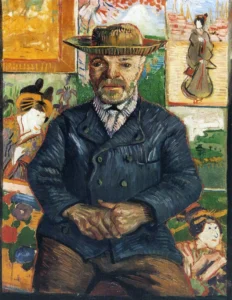
Vincent’s obsession with Japanese woodblock prints (Ukiyo-e) redefined his sense of space and composition. From masters like Hiroshige and Hokusai, he learned the power of bold outlines, flat color planes, and asymmetrical perspectives. This "Japonaiserie" influence liberated his work from the constraints of 19th-century European perspective, leading to a unique synthesis that felt both ancient and radically modern—a shift also explored by his contemporary Edgar Degas.
He saw Japan as a land of pure light, a vision that eventually led him south to Arles. This cross-cultural fusion is why Van Gogh’s work feels so at home in modern, minimalist interiors that value clean lines and bold color statements. At DafenArts, we use the same bold, dark outlines found in his "Japanese" phase to ensure the graphic clarity of each reproduction.
The Arles Zenith: The Yellow House and Chrome Yellow
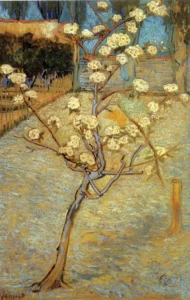
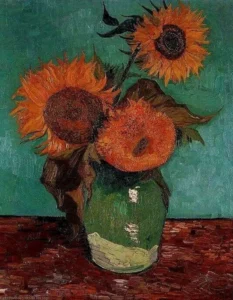
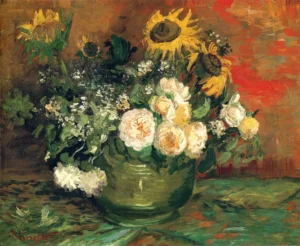
In 1888, Vincent moved to Arles in search of the "Sun of the South." In the famous Yellow House, he entered his most prolific phase, often completing a canvas in a single day. He was enchanted by the orchards in bloom, the drawbridges, and the starry nights over the Rhone. The Sunflowers series was more than a decorative exercise; it was a psychological welcome for his friend Paul Gauguin.
For Vincent, yellow was the color of gratitude, friendship, and spiritual renewal. He utilized Chrome Yellow pigments to create a brilliance previously unseen in Western art—a radiance that we meticulously recreate in our Dafen studio using modern, light-fast equivalents. This ensures that your hand-painted "Sunflowers" or "Yellow House" remains as vibrant in fifty years as the day it was painted, avoiding the darkening effect often seen in historical museum pieces.
The Physics of Passion: Starry Night and Turbulent Flow
While at the asylum of Saint-Paul-de-Mausole, Vincent found solace in the restricted view from his barred window. It was here, during a period of alternating lucidity and crisis, that he painted The Starry Night in 1889. Modern physicists have analyzed the swirling patterns in this painting and discovered they align perfectly with the mathematical principles of "turbulent flow" in fluid dynamics—a phenomenon also hinted at in the enigmatic smiles of Leonardo da Vinci.
Vincent’s ability to replicate this invisible, chaotic force of nature suggests an intuitive grasp of the universe's underlying energy. His brush was not just applying paint; it was mapping the wind, the heat, and the cosmic pulse. This is why a digital print feels flat and lifeless; it cannot capture the physical "vortex" created by the heavy impasto. Our 100% hand-painted reproductions capture this topography, allowing the painting to "breathe" and interact with the ambient light in your room.
Notes from the Atelier: Recreating the Impasto Sculpture
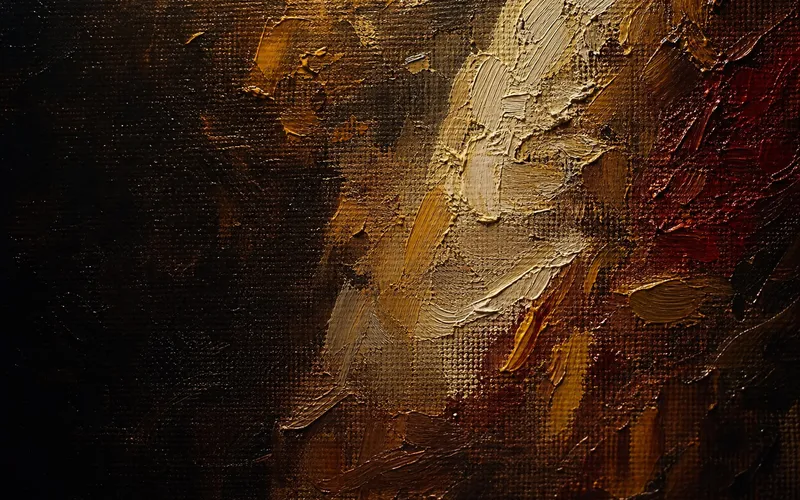
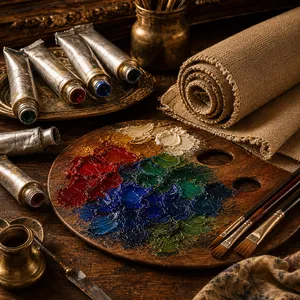
At DafenArts, we understand that a Van Gogh is a sculpture made of oil. When our master painters recreate the rolling clouds of Saint-Rémy or the rugged bark of an olive tree, they use a "Heavy Body" medium. This ensures that the ridges of the brushstrokes—the impasto—catch the light. As the sun moves from morning to evening, the shadows and highlights on the canvas change, making the painting feel alive.
Unlike flat, mass-produced canvas prints, our reproductions have a three-dimensional soul. We use premium linen canvases that can withstand the weight of the heavy paint layers, ensuring the structural integrity of the work. This is the "DafenArts Difference"—we don't just copy the image; we recreate the physical choreography of Vincent's hand, honoring the techniques found in the Musée d'Orsay.
The Final Act in Auvers-sur-Oise and Wheatfield with Crows
In his final 70 days at Auvers-sur-Oise, Vincent painted at a frantic pace, producing over 70 canvases. Under the care of Dr. Paul Gachet, his works took on a more somber, turbulent tone, reflecting his precarious mental state. Masterpieces like Church at Auvers show a world where even architecture seems to breathe and undulate.
His late works, specifically Wheatfield with Crows, are often misinterpreted as mere suicide notes. In reality, they are masterclasses in controlled chaos and the power of complementary colors. The dark blue sky crashing against the golden grain creates a tension that is both beautiful and terrifying. At DafenArts, we focus on the "directional energy" of these late strokes, ensuring the final, desperate brilliance of his life is captured with 100% hand-painted precision.
A Legacy Beyond the Museum Walls
Vincent sold only one painting in his life, but today he is the world's most recognizable artist. This transition from "failure" to icon is largely due to Johanna van Gogh-Bonger, Theo’s widow. She understood that Vincent’s letters were the key to his art, and she worked tirelessly to organize exhibitions. Today, his work bridges the gap between the revolutionary past and the modern emotionality seen in artists like Edouard Manet.
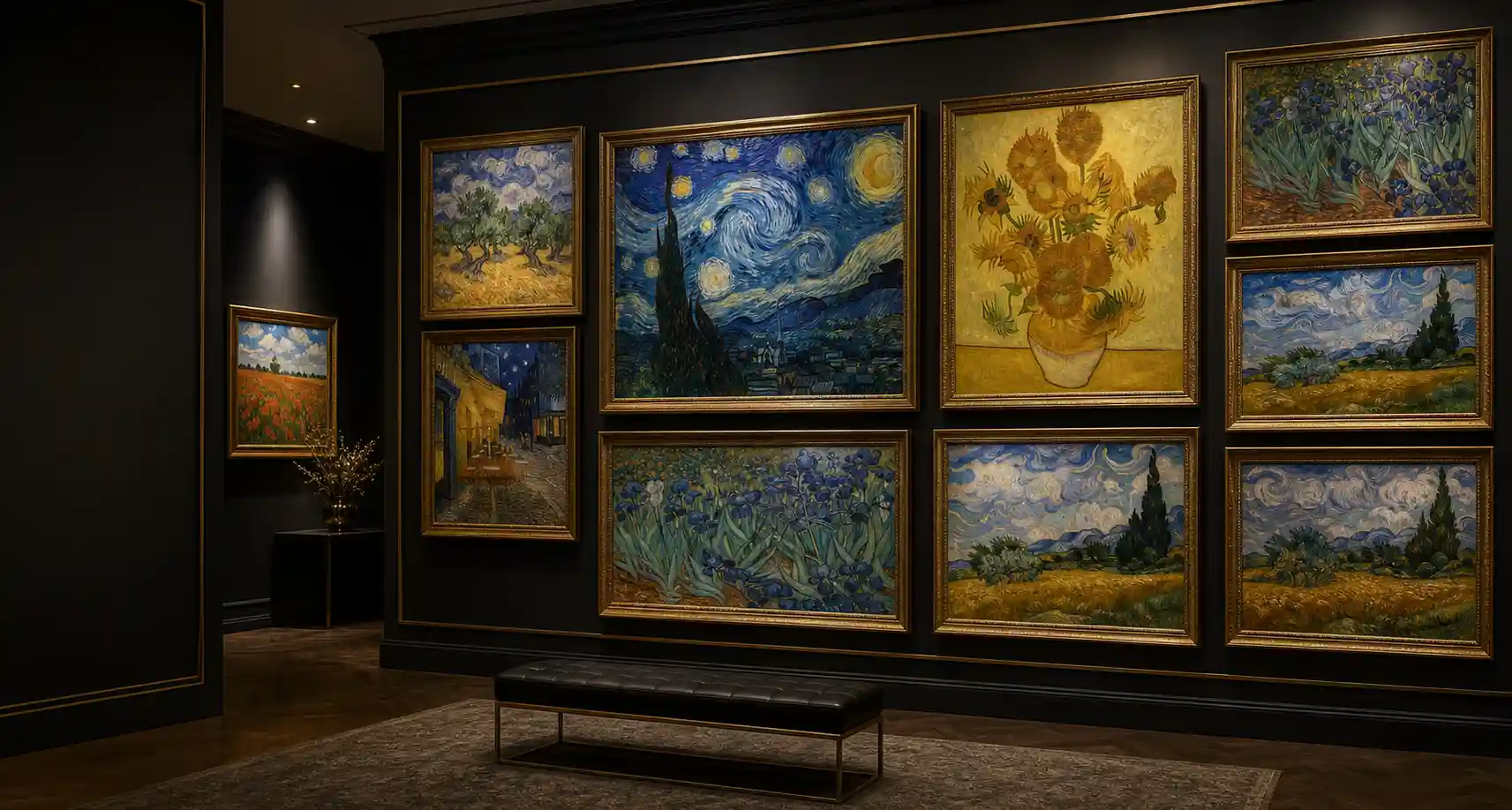
DafenArts serves as a bridge between this historical genius and your modern home. In an age of digital imagery, the "Human Touch" is a rare luxury. By selecting a hand-painted reproduction, you are not just buying decor; you are investing in a piece of art history that celebrates the discipline and vision of one of the world's greatest masters. Explore our Johannes Vermeer or Claude Monet collections to see the full spectrum of our hand-painted standard.
Curator’s Advice for Collectors: Distinguishing Hand-Painted Art
When selecting a museum-quality reproduction, the artist's understanding of the "rhythm" of the stroke is paramount. Each of Vincent's dashes had a specific direction and weight, a technique known as "tessellation." Our artists spend years studying these patterns to ensure that every replica is an honest tribute to the master's hand.
Always look for the topography. A true hand-painted piece must possess depth. When you observe a DafenArts canvas from an angle, you should see the physical ridges of the brush. This three-dimensional quality is what allows the painting to "interact" with the lighting in your home, creating a soul that a flat surface can never replicate. By using traditional pigments and high-density oils, we ensure your investment remains a museum-quality heirloom for generations to come.
The reproduction challenge is translating directional brushwork and color pressure into visible oil paint rather than flat printed color.
Living rooms, studies, gallery walls, boutique hotels, and expressive focal walls.