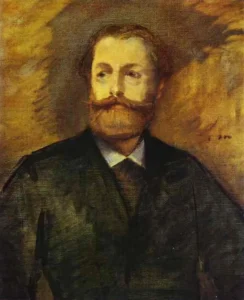
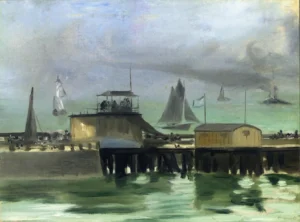
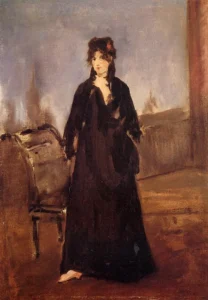
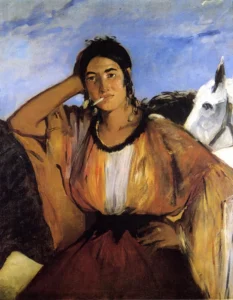
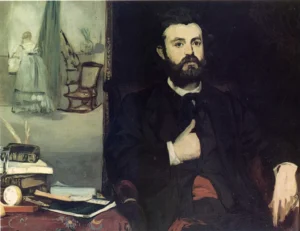
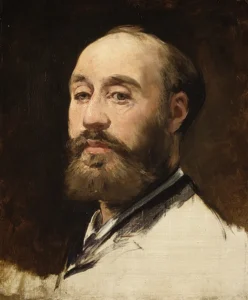
Portrait of Édouard Manet: The father of modernism whose work inspires our collection.
Edouard Manet was a French painter who was one of the first 19th-century artists to paint modern life, and a pivotal figure in the transition from Realism to Impressionism. His early masterpieces, The Luncheon on the Grass and Olympia, sparked great controversy but served as rallying points for the young painters who would create Impressionism. Today, he is regarded as the father of modern art.
To own a Manet is to possess a piece of art history that challenged the status quo. His work is characterized by flat color planes, sharp contrasts, and a directness that stripped away the idealized gloss of academic art. At DafenArts, we recreate his bold vision using traditional "Alla Prima" techniques, ensuring that each hand-painted reproduction captures the rebellious spirit and sophisticated urbanity of 19th-century Paris.
“There is only one true thing: instantly paint what you see. When you've got it, you've got it. When you haven't, you begin again. All the rest is humbug.” — Edouard Manet
Edouard Manet: The Father of Modernism and Artistic Rebellion
Edouard Manet (1832–1883) was a revolutionary who dismantled the rigid, often stifling conventions of the Parisian Salon. Unlike his younger peers like Claude Monet, Manet did not consider himself a pure Impressionist; instead, he sought to reform the Academy from within. He was the "painter of modern life" that Charles Baudelaire envisioned—a flâneur of the canvas who captured the cafes, the boulevards, and the complex social hierarchies of a rapidly industrializing Paris.
His rejection of the obsession with seamless blending and mythological themes was a declaration of independence. He opted for a visceral, direct application of paint that prioritized "visual truth" over the forced narrative storytelling of his contemporaries. By simplifying forms and utilizing bold black outlines—a technique deeply influenced by Spanish masters like Velázquez and Goya—Manet allowed the canvas to speak with a newfound graphic intensity. This shift was monumental; it transformed wall art from a passive, illustrative window into a sophisticated and often confrontational "Statement Piece" for modern collectors who appreciate both the weight of history and the sharp edge of avant-garde aesthetics.
Early Life and the Scandal of the Salon
Manet was born into a high-society Parisian family, the son of a judge. Despite immense parental pressure to pursue a career in law or the navy, Manet's unshakable commitment to art led him to the studio of the classical painter Thomas Couture. However, his true education occurred outside the classroom, within the galleries of the Louvre and through extensive travels to Spain and the Netherlands. He was a devoted student of tradition who possessed the rare courage to use that very knowledge to subvert it.
His breakthrough came not through praise, but through scandal. In 1863, The Luncheon on the Grass (Le Déjeuner sur l'herbe) was rejected by the official Salon, only to become the infamous sensation of the Salon des Refusés. Two years later, Olympia shocked Paris once again by portraying a modern woman—not a goddess—with a direct, unapologetic gaze that demanded the viewer acknowledge her reality. These fierce struggles for recognition solidified Manet’s role as the de facto leader of the avant-garde, a position he shared with close friends like Edgar Degas, even as he maintained his own unique, realistic path that refused to fully dissolve into the misty light of his Impressionist colleagues.
The Revolutionary "Alla Prima" Technique
Manet’s greatest technical contribution to the evolution of painting was his mastery of the "Alla Prima" (wet-on-wet) approach. Instead of the slow, grueling academic method of building up dozens of transparent glazes over months, Manet often painted "all at once," applying bold, opaque layers of pigment that retained their freshness, spontaneity, and luminosity. He favored flat planes of color and sharp, almost photographic lighting that anticipated the development of modern graphic design and the "Pop Art" movement decades later.
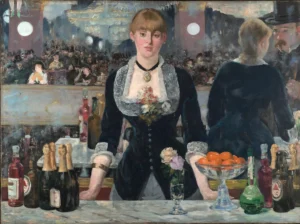
At DafenArts, our master painters spend years studying these specific, decisive brushwork patterns. We understand that an Edouard Manet reproduction must have a "physical presence"—a weight and gravitas that only genuine oil on heavy-duty linen canvas can provide. We recreate the bold, decisive strokes found in his late masterpiece, A Bar at the Folies-Bergère, ensuring that the shimmering reflections of the glass bottles, the electric glow of the chandelier, and the hauntingly detached gaze of the barmaid are captured with 100% hand-painted precision.
The Masterpieces of Modern Urbanity and Isolation
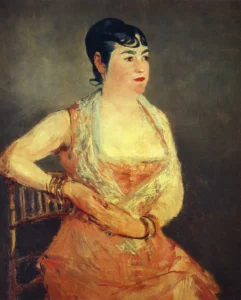
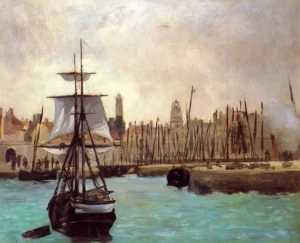
Manet was the ultimate chronicler of the Parisian bourgeoisie and the hidden loneliness of the modern city. His subjects were the people of the street, the theater, and the bar—the fleeting characters of the Belle Époque. From the scandalous, confrontational Olympia to the serene, light-filled Boating, his work reflects the ambiguity and emotional isolation of modern existence.
These works are far more than mere decorations; they are psychological portals. They are the perfect choice for "Living Room Wall Art" or high-end "Office Decor," offering a sense of intellectual sophistication and social commentary. Our Manet series is hand-painted with a rigorous focus on his unique palette—specifically his legendary use of "Velvety Black" and cool, silver grays that ground his compositions in a sense of timeless cool. His influence is felt in every major movement that followed, from the intense emotional depth of Vincent van Gogh to the rigorous geometric constructs of Paul Cézanne.
Evolution of Style: From Tradition to Modernity
Period Subject Focus Artistic Goal Technical Approach
Early Realism Spanish themes & Bullfights To modernize classical tradition Strong contrasts & dark, "Spanish" palettes
The Scandal Years Modern nudes & Social scenes To challenge academic "Finish" Flat color planes & bold, graphic outlines
High Modernism Urban cafes & Racecourses To capture the "Spectacle" of Paris Direct "Alla Prima" & vivid lighting
Late Style Floral Still lifes & Portraits To capture fleeting mood & light Fragmented brushwork & brighter tones
Notes from the Atelier: The DafenArts Craft
At DafenArts, we recognize that a Manet reproduction requires what we call a "Decisive Stroke." Unlike the soft, repetitive dabs of the Impressionists, Manet’s work demands a confident, highly structured application of paint. Our artists use premium, professional-grade oils with an extremely high pigment density to achieve his signature "enamel-like" finish.
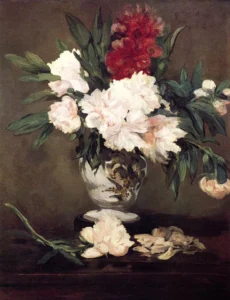
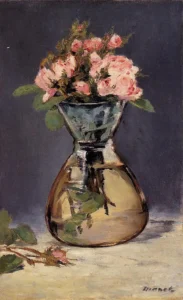
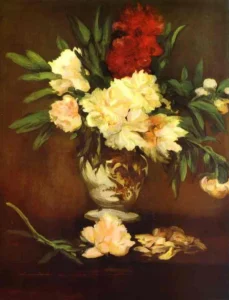
Unlike flat, lifeless digital prints, our 100% hand-painted canvases interact dynamically with the light in your room. The physical depth of the "Impasto" (thick paint) in a Manet floral still life or the smooth, creamy texture of a figure's skin creates a three-dimensional topography that no machine can ever replicate. This is a living tribute to the Musée d'Orsay originals, designed to be felt as much as seen. We use traditional linen because it provides the structural resistance necessary for Manet's bold, aggressive brushwork.
A Legacy Beyond the Mass-Produced Print
In an era of disposable digital imagery and AI-generated filters, a hand-painted Edouard Manet reproduction is a rare luxury that speaks to the endurance of the human spirit. DafenArts serves as the cultural bridge between the revolutionary spirit of 19th-century Paris and your modern home. We use only archival-quality materials—heavy-duty linen and light-fast pigments—to ensure that your investment remains as vibrant and provocative as the day it was painted, resisting the fading common in lesser replicas.
Owning a Manet is an invitation to engage with the very birth of modernism. It is a statement of taste, intelligence, and a profound respect for the "Human Touch." By selecting a DafenArts reproduction, you are preserving the legacy of the man who dared to paint the uncomfortable truth of his own time, paving the way for everything we call "Modern Art."
Curator’s Advice for Art Collectors
When selecting a museum-quality Manet, pay close attention to the treatment of the "Blacks." Manet used black not as a void or an absence, but as a vibrant, structure-giving color that defined space and form. A true hand-painted reproduction must show the richness, depth, and variety of these dark tones. Observed from an angle, the canvas should reveal a sophisticated texture that doesn't just reflect light, but actually shapes it.
Consider the framing for a Manet; his bold, rebellious compositions often benefit from heavy, classic gold-leaf frames that provide a traditional anchor to his avant-garde subjects, creating a beautiful tension in your interior design. Whether you choose the iconic, confrontational Olympia or a delicate, intimate floral still life, our goal is to provide a hand-painted heirloom that brings the rebellious elegance of the Parisian Belle Époque into your daily environment. Explore more masters like Johannes Vermeer or Rembrandt to complete your private gallery.
The reproduction challenge is tonal clarity: dark passages and light skin or fabric need firm separation in real oil paint.
Studies, dining spaces, formal corridors, gallery walls, and interiors that can hold a direct figure image.